
Why Sydney Businesses Choose NexusByte to Secure, Scale and Support Their Technology
Almost nobody shops for an IT provider while everything is working. The search usually starts on a bad morning — a mailbox that will not sync before a client meeting, a point-of-sale terminal that has dropped off the network, an invoice from a vendor nobody can explain. By the time a business owner is comparing providers, they are already paying for the gap.
That timing shapes what people ask us. The question is rarely "what is in your stack". It is closer to: who actually picks up, how quickly does someone get here, and will this still make sense in two years when we have doubled the team? Those are fair questions, and they are the ones this article answers.
What managed IT actually covers, in plain terms
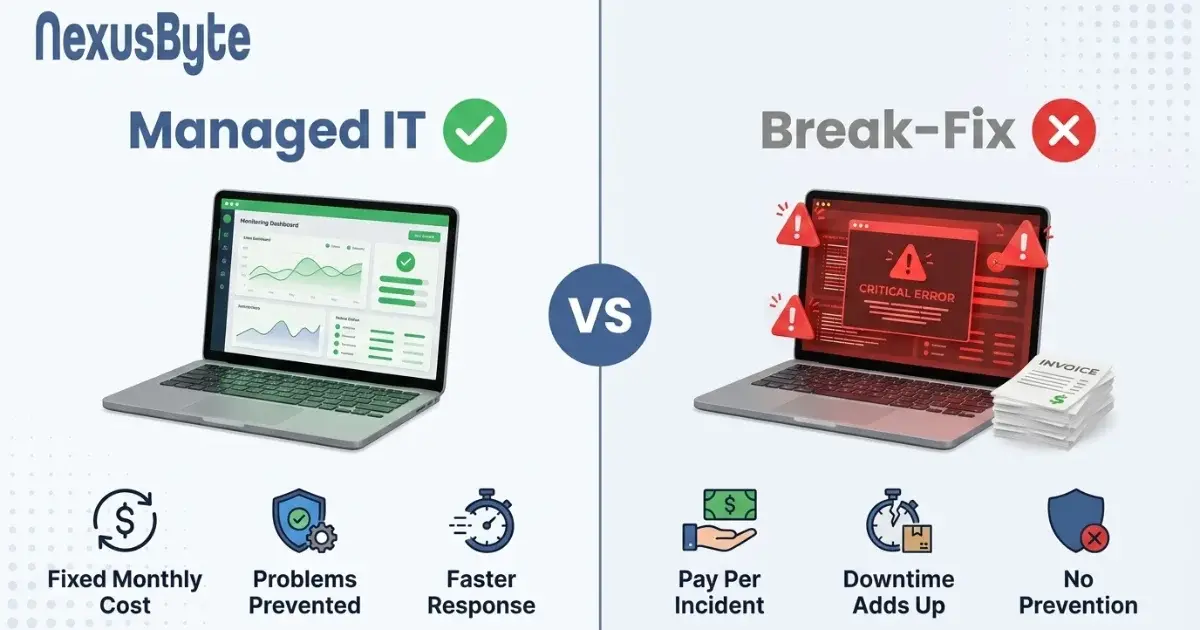
"Managed IT" is a term that has been stretched until it means very little. Stripped back, it describes four jobs. Someone has to keep the day-to-day running — accounts, devices, printers, mailboxes, the shared drive. Someone has to watch the infrastructure so that a failing disk or a full mailbox database is caught while it is still a warning rather than an outage. Someone has to own security, including the parts nobody enjoys, like reviewing who still has access after they have left. And someone has to think a year ahead, so the network you install this month is not the thing blocking you next winter.
Plenty of providers do the first job well and quietly skip the fourth. That is where the friction usually shows up later: a business grows from eight staff to twenty-five and discovers that its internet plan, its switch, its backup regime and its licensing were all sized for the old company. Getting proactive monitoring in place early is far cheaper than an emergency migration in the middle of a busy quarter.
We come to you — that is the whole model
NexusByte is based in McMahons Point, but the office is not where the work happens. Our technicians travel to the client for every service we offer, whether that is a network fit-out in an office in the CBD, a server cutover in a warehouse out west, or a workstation rebuild at a home office on the North Shore. The Blues Point Road address is for scheduled appointments, not walk-ins.
This matters more than it sounds. A great many IT problems are physical: a patch lead half-seated in a wall port, a router sitting inside a metal cabinet, a printer on a different subnet to everyone trying to print to it. Those are ten-minute fixes in the room and week-long email threads from a call centre. Remote tools are genuinely faster for software, accounts and configuration, and we use them first when they are the right tool — but when the answer is on site, somebody drives.
Security judged against Australian standards, not vendor marketing
Small and mid-sized businesses are not too small to be targeted; they are targeted precisely because their defences are usually thinner than an enterprise's. The practical benchmark in this country is the Australian Signals Directorate's Essential Eight — application control, patching applications and operating systems, restricting administrative privileges, configuring macro settings, hardening user applications, multi-factor authentication and regular backups.
It is a useful framework because it is specific and it is measurable. A business can be told honestly where it sits on each of the eight, at which maturity level, and what the next step costs. We work through it with clients as a staged plan rather than a single invoice, and we are equally clear about which controls will genuinely change their risk and which are being oversold to them. Our Essential Eight compliance work sits alongside broader networking and cybersecurity services for firewalls, endpoint protection and identity.
The other half of the picture is legal rather than technical. Under the Privacy Act and the Notifiable Data Breaches scheme, a business that suffers an eligible breach of personal information has obligations to the affected people and to the OAIC. Knowing where customer data actually lives — and being able to demonstrate it — is part of the job. That is a large part of why data management, retention and recovery planning belong in the same conversation as security rather than in a separate one.
One partner across the whole stack
Most businesses accumulate technology suppliers rather than choosing them: one company built the website, another sells the phones, a third looks after the computers, and none of them will own a problem that sits between two of those things. Consolidating removes the finger-pointing, and it means the person advising on your infrastructure already knows what your applications need from it.
We cover the range in-house. Web development for the public-facing side, including e-commerce websites, tradies websites and medical and healthcare websites. Day-to-day business IT support and hands-on computer repairs for when hardware fails. Software development when an off-the-shelf product genuinely does not fit the way a business works. The full service list sets out where each one starts and stops.
Six questions worth asking any provider before you sign
These are the questions we would want a prospective client to ask us, and they are just as useful pointed at anyone else.
Who answers when I call, and what happens after hours? Ask for the actual escalation path, not a response-time figure in a brochure.
Do you attend on site, and is it billed separately? A provider who is remote-only will quietly push physical problems back onto your staff.
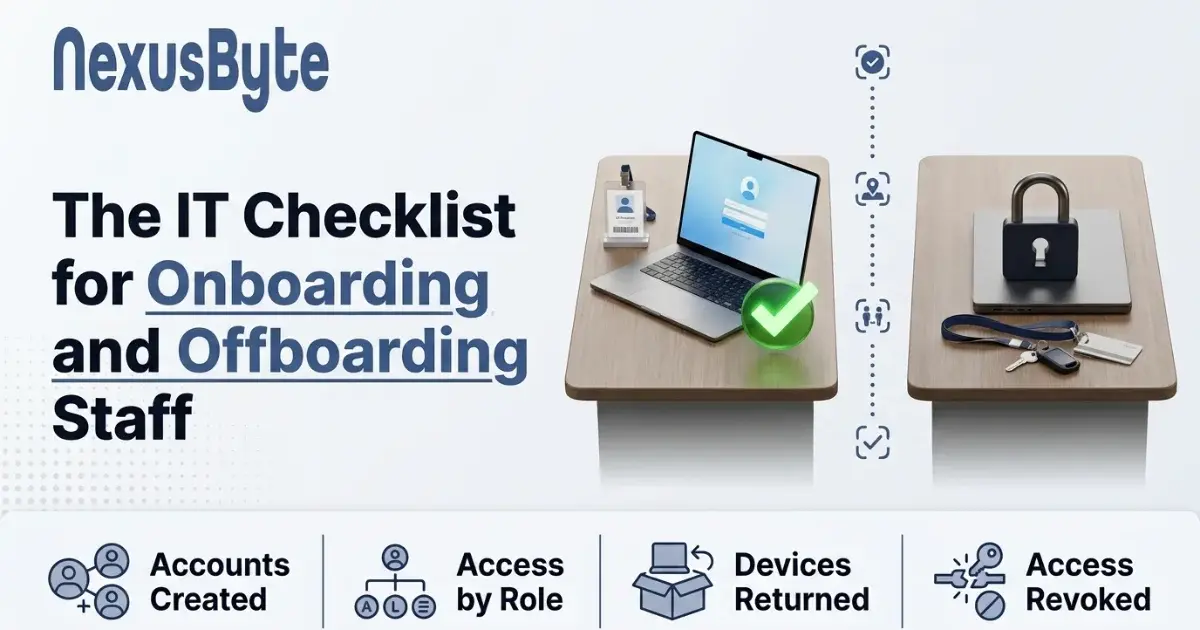
Who owns our accounts, domains and licences? They should be registered to your business, not to the provider. This is the single most common trap we find when taking over from another supplier.
When was the last time our backups were restored, not just taken? A backup that has never been tested is a hypothesis.
What does leaving look like? A confident provider can describe an orderly handover, including documentation and credentials.
What would you fix first, and why that? The answer reveals whether they have looked at your business or are reciting a package.
How an engagement usually starts
The first step is a conversation and a look at what is actually in place — devices, accounts, network gear, backups, who has access to what. That audit is worth doing even if it goes no further, because most businesses have never had their environment written down in one place.
From there we set out what needs attention now, what can wait a quarter, and what is fine as it is. Not everything on the list has to be done by us, and we say so when something is better handled by an existing supplier or by the client's own team. Businesses stay with providers who are straight with them about that, which is ultimately the whole answer to why companies stay with us.
If you would like that first look at your environment, get in touch and we will arrange a time.