

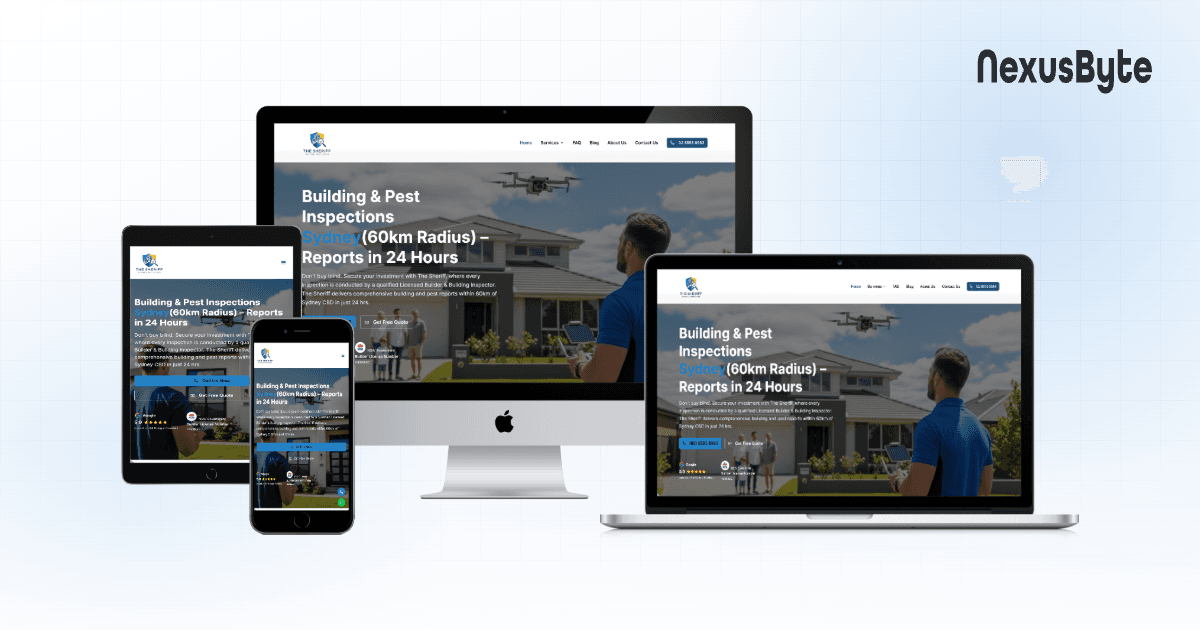
The Sheriff Building Inspections
The Sheriff has been inspecting Sydney property since 2014, with licensed builders doing the inspecting and reports turned around inside a day. thesheriff.com.au runs on Next.js with Strapi managing services, suburbs and articles.
Seventeen services that are not variations
The service list is the defining constraint of this build. Seventeen inspection types sounds like a taxonomy exercise until you look at what they are, at which point it becomes obvious they are not variants of one product. A pre-purchase building and pest inspection is bought by someone with a cooling-off period ticking. A dilapidation report is bought by a developer protecting themselves against a neighbour's future claim, and has to survive a courtroom. A construction stage inspection is bought by an owner who does not trust their builder. A practical completion handover, and the two-year and six-year statutory warranty inspections that follow it, are bought against a legislated clock.
Then there are the ones bought because something has already gone wrong: hidden defect inspections, moisture assessment and leak detection, water leak identification, emergency assessment after a storm. And the ones bought for a transaction: pre-sale vendor inspections, rental and investment condition reports, insurance condition reports across NCC classes 1 to 10a. Each of those is a different person, in a different mood, at a different moment. So each page opens with the situation that sent them searching rather than with a description of the inspection — because the reader is not shopping for an inspection, they are trying to resolve a specific worry.
Standards treated as content, not badges
This is a purchase made almost entirely on trust, by someone who cannot evaluate the work and often cannot attend. The usual response is a row of membership logos in the footer, which persuades nobody because everybody has them. Instead the credentials are written out where they are relevant: the NSW builder licence number, the industry memberships, and the Australian Standards the work is actually performed under — AS 4349.1 for building inspections and AS 3660 for termite and timber pest — named on the services they govern rather than pooled on an About page.
The technology gets the same treatment. Thermal imaging, acoustic detection, moisture meters and drone survey are not listed as features; they are attached to the problem each one solves, so a reader understands why a roof can be assessed at high resolution without scaffolding, or how a leak inside a wall gets found without opening it. That is the difference between a capability list and an argument.
Turnaround is the product
In pre-purchase work the report is worthless if it arrives after the deadline, so speed is treated as a headline commitment rather than a service detail: same-day reports on the inspections that support them, 24 hours as the general standard, 24 to 48 hours for dilapidation reports. Publishing those separately rather than as one blended promise is the honest version, and it is also the more persuasive one — a specific number reads as a process, while "fast turnaround" reads as marketing.
Coverage runs to a 60km radius of the CBD, grouped into the six regions people actually identify with — Eastern Suburbs, Inner West, North Shore, southern suburbs, western suburbs and Northern Beaches — with real suburbs named under each. Beside the standard booking path sits a 24/7 emergency route for storm damage and structural concern, kept visible without making every routine enquiry feel like a crisis. Sites carrying this much service depth are the shape our business website service is built for.
The SEO build
Seventeen services across six regions is a large surface area to compete on, and the strategy is to let each service page own its own search rather than pushing everything through the homepage. Each carries its own title, description and canonical, which is only possible because they were written as genuinely different pages rather than generated from one template — the technical setup and the editorial decision are the same decision here.
The structured data marks the business as a LocalBusiness with an AggregateRating exposing the review standing, an OpeningHoursSpecification, and City and AdministrativeArea entities describing the coverage so the 60km radius is machine-readable rather than merely written. The title leads on the exact phrase the service is searched by — building and pest inspections Sydney — before the business name. Canonicals, Open Graph and Twitter cards, and a 43-URL sitemap declared in robots.txt round it out, so every service and suburb page is offered to Google explicitly instead of waiting to be discovered.
The Challenge Of Project
- Keeping seventeen inspection services genuinely distinct, each opening with the situation that sent someone searching rather than a description of the inspection.
- Writing licences, memberships and the Australian Standards into the services they govern, instead of pooling them as footer logos nobody reads.
- Attaching each piece of equipment — thermal, acoustic, moisture, drone — to the problem it solves, turning a capability list into an argument.
- Publishing turnaround times per service rather than as one blended promise, since a report that misses a cooling-off deadline has no value at all.
- Running a 24/7 emergency route beside the normal booking flow without making every routine enquiry feel like a crisis, or burying the genuine one.