

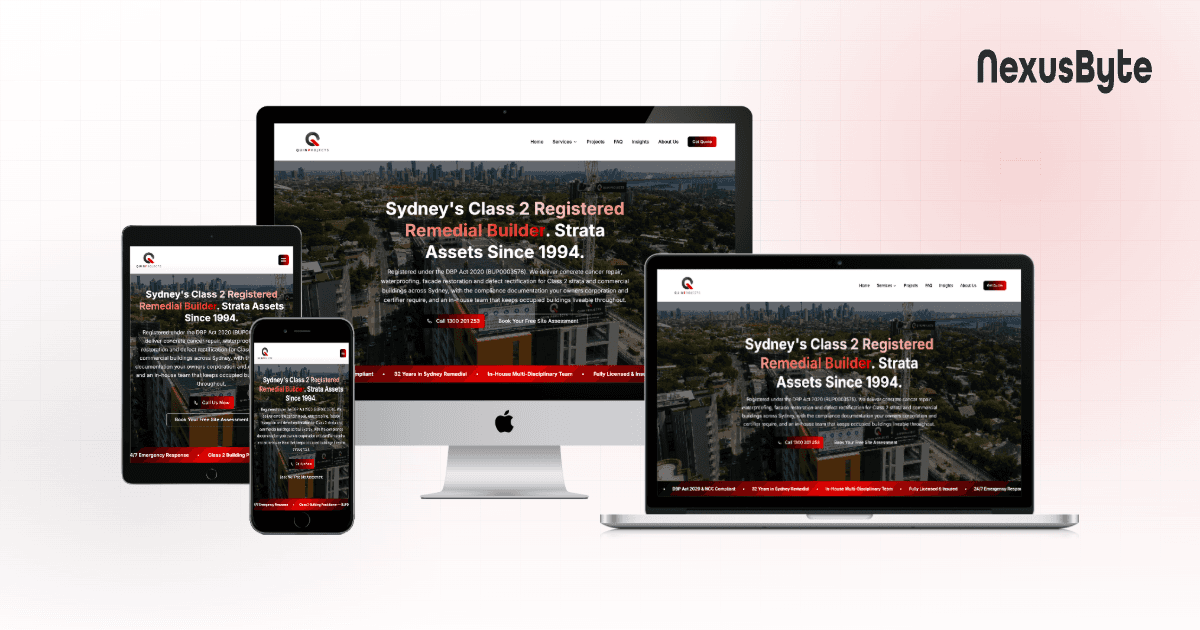
Quin Projects
Quin Projects is a remedial building specialist of thirty-two years, working strata and commercial property out of Rose Bay across Sydney's Eastern Suburbs. quinprojects.com.au was built on Next.js with Sanity as the content platform.
The reader is holding an engineer's report
This is the fact that shaped every decision on the project. Almost nobody arriving at this site is a homeowner browsing. They are strata managers, building managers and committee members, and they are usually reading because a defect report or an engineer's assessment has landed on their desk with a term in it they need to understand and a cost they will have to justify to owners. That reader is not looking to be reassured. They are looking for a contractor who can be put in front of a committee without embarrassment.
So the copy leads with the defect rather than with the company. Concrete spalling and crack injection, waterproofing systems for bathrooms, balconies, roofs and wet areas, structural steel corrosion treatment, balcony and facade restoration, basement crack injection with moisture control, roof membrane repair, external wall cladding, building envelope sealing, defect rectification and NCC compliance upgrades. Each of those is a search term someone types after reading it in a report, which means the page that names it plainly is the page they find.
Compliance is the entry ticket
Since the Design and Building Practitioners Act 2020, remedial work on Class 2 buildings in NSW cannot be done by whoever quotes cheapest. Registration as a Class 2 Building Practitioner is a legal prerequisite, and a strata manager who engages an unregistered contractor has a problem of their own. That turns the registration from a credential into a filter — the first thing a professional buyer checks and the reason most enquiries proceed or stop. It is therefore stated where a committee will find it in seconds, not buried on an About page, along with the building classes served: Class 2, 3 and 9c.
The Insights section extends the same logic. Articles on the DBP Act, concrete cancer treatment and balcony waterproofing exist because those are the questions that arrive before a quote is ever requested, and answering them is how a contractor demonstrates they understand the regulatory environment rather than just the trowel work. For a buyer who will have to defend their choice of contractor at a general meeting, that is the evidence they need.
Two businesses on one site
There are actually two offerings here with different rhythms. Remedial work is project-based, tendered, engineered and occasional. Property maintenance is continuous — preventive programs for Class 2, 3 and 9c buildings, 24/7 emergency repairs, plumbing, electrical and HVAC servicing, doors and windows, flooring, painting and general upkeep. The same strata manager buys both, but at different times and with different decision paths, so the site keeps them structurally separate rather than merging them into an undifferentiated capability list.
Case studies shaped for a committee
Project pages are modelled in Sanity around building type, defect and remedy, because that is the shape a manager reads — they are looking for the job that matches the report in their hand. Published examples cover fire safety compliance at Bondi Beach, glass balustrade replacement at Rozelle and concrete crack injection at Randwick. Testimonials come from property managers rather than residents, and the partner list does quiet work: for a committee, seeing the strata organisations a contractor already works with is more persuasive than any adjective. This is the same audience-first approach behind our business website service.
The SEO build
The nicest piece of technical work on this site is small and easy to miss: the DBP Act registration is published as an EducationalOccupationalCredential in the structured data. The credential is not just written on the page for a human to read — it is expressed in a form a search engine can parse and attribute to the business. For a contractor whose entire commercial position rests on being registered where most competitors are not, making that machine-readable is exactly the right investment.
Around it sit a LocalBusiness and Organization pairing, every service as a Service entity within an OfferCatalog, State and City entities with a GeoCircle for the Eastern Suburbs footprint, a BreadcrumbList for the deep service hierarchy, and FAQPage markup on the questions strata managers actually ask. The title is unusually disciplined for the trade — remedial builder Sydney, Class 2 registered — putting the search term and the qualifying credential in the space Google displays, with the business name left off entirely. A 105-URL sitemap is declared in robots.txt.
The Challenge Of Project
- Writing for strata and building managers rather than homeowners, which means leading with compliance and evidence instead of reassurance and kerb appeal.
- Naming defects the way an engineer's report names them, because that is the exact phrase a manager types after reading it.
- Putting DBP Act registration and building classes where a committee finds them in seconds, since under that Act the credential is a legal filter, not a nicety.
- Keeping project-based remedial work and continuous maintenance structurally separate, because the same manager buys them at different moments and in different ways.
- Explaining remedial work accurately without turning the site into an engineering document a committee stops reading after the first paragraph.