

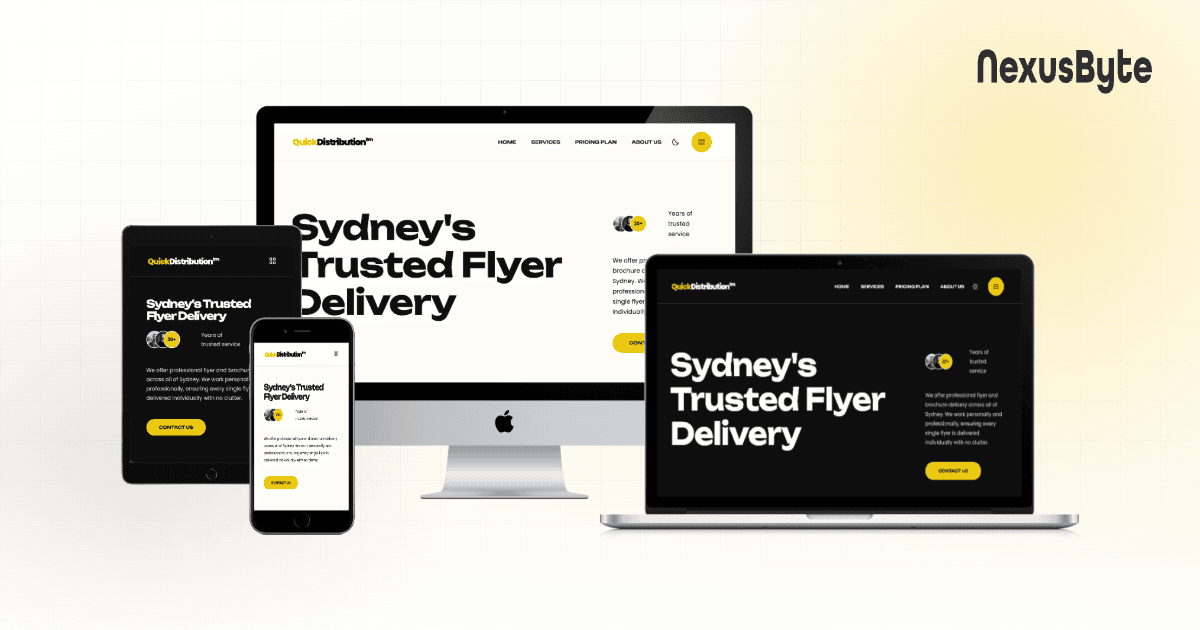
Quick Distribution
Quick Distribution has been delivering flyers and brochures around Sydney since 2004, from a base in Balmain. quickdistribution.com.au is a Next.js build for a business whose product is simple to describe and surprisingly hard to buy with confidence.
The trade's credibility problem
Letterbox distribution has an unusual commercial difficulty: the customer can never verify the product. You hand over ten thousand flyers, they disappear into a van, and some weeks later you have a vague sense of whether the phone rang more than usual. Everybody in the industry knows the stories about bundles going into a skip, and every prospective customer is quietly wondering about it. No amount of friendly copy about reliability addresses that, because the operator who does bin them says exactly the same things.
So the site was designed to answer the suspicion structurally rather than rhetorically. Individual delivery with no bundling is stated as an explicit commitment rather than an implied standard — bundling being the specific practice that lets a walker cover a suburb in a fraction of the time and renders the campaign worthless. Delivery reporting appears at every tier and real-time tracking from the mid tiers up, which converts an act of faith into something with a record attached.
Publishing the price list
The decision that most shapes this site is the published rate card. Five tiers run from 1,000 flyers at $120 through 5,000 at $495, 10,000 at $990 and 20,000 at $1,800 up to 50,000 at $4,500, each listing exactly what comes with it — pickup, delivery reports, priority scheduling, real-time tracking, a dedicated team, campaign strategy support and volume discounts as the numbers climb.
Very few operators in this trade publish anything. The instinct is that quoting privately preserves room to move, and there is a real argument for it. But it also means every enquiry starts as a price question, which is the least useful conversation a distribution business can have. Publishing the numbers filters out the customers who were never going to buy, brings in the ones who have already accepted the cost, and shifts the first conversation to coverage and timing. It also does something subtle for trust: an operator who will state a price in public is implicitly stating they will not adjust it once you are committed.
Three services, three different buyers
Local drops serve real estate agents and event organisers who want saturation of a named suburb and usually want it this week. Custom campaigns serve businesses that want to select suburbs individually across Sydney-wide coverage, which is a planning conversation rather than a booking. Government and election distribution is a separate service for a good reason: council election material and parliamentary mail carry compliance obligations and delivery expectations that ordinary commercial drops do not, and the client organisation buying it is answerable for how it was handled.
Underneath all three sits the asset the business has actually accumulated over twenty years: knowledge of the streets. Which buildings have accessible letterboxes, which estates need a different route, where a walker loses half an hour. That is unglamorous and impossible for a new competitor to replicate quickly, so the site treats it as the differentiator it is. Businesses selling a service this hard to verify are the kind our business website service is built around.
The SEO build
The published pricing pays off twice, and the second time is in search. Because the tiers are real page content rather than a PDF or a form gate, they are indexable, which means the site can compete for the cost-shaped queries — how much does flyer distribution cost — that most operators cede entirely. The tiers are also marked up as Offer entities within an OfferCatalog, so the pricing is machine-readable rather than only human-readable.
The rest of the structured data is unusually complete for a business this size: LocalBusiness and Organization, Service entities, Review and AggregateRating exposing the review standing, FAQPage on the common questions, a BreadcrumbList, and a WebSite entity with a SearchAction. The title carries the category, the city and the founding year — Sydney's trusted flyer delivery service, est. 2004 — because in a trade with a trust problem, longevity is the strongest signal available in a search result. Canonicals, Open Graph, Twitter cards and a declared sitemap complete the setup.
The Challenge Of Project
- Designing a public rate card for a trade that quotes privately, so the numbers read as confidence rather than as a ceiling to be negotiated down from.
- Answering the trade's central doubt — did the flyers actually get delivered — with a no-bundling commitment and reporting stated before the order, not after it.
- Making each tier's inclusions legible at a glance, so a customer can see what they gain by stepping up rather than only that the number is bigger.
- Handling election and government distribution as its own service, since that work carries compliance obligations an ordinary letterbox drop does not.
- Presenting twenty years of route knowledge as the real asset, since it is the one thing a new competitor cannot undercut its way past.