

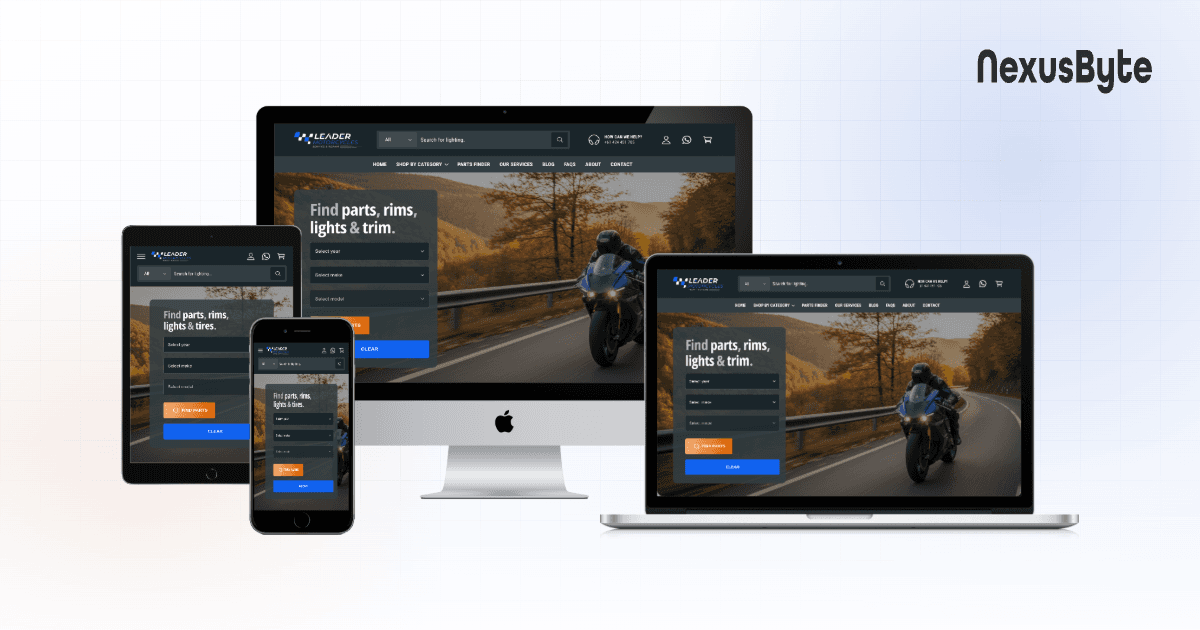
Leader Motorcycles
Leader Motorcycles sells parts, rims, lights, electrics and gear to Australian riders, and runs a real workshop alongside the online business. leadermoto.com.au is a Shopify build carrying a catalogue of more than 25,000 products.
Twenty-one thousand hard parts
The numbers explain the whole project. Hard parts alone run past 21,000 items — engine components, transmission, suspension, brakes — with 1,830 apparel lines, 751 accessories, 717 workshop tools and 221 lubricants behind them. At that scale, a conventional category tree stops being navigation and becomes an obstacle course. Nobody drills through six levels to find a stator, and a customer who cannot find a part in ninety seconds assumes you do not stock it.
The complication is that a motorcycle part is not really a product — it is a relationship between a product and a machine. The same visual component is right for one model year and wrong for the next, and "wrong" means a return, a bike on a stand and a customer who does not come back. Fitment, not category, is the axis that matters, which is why the store leads with a part finder rather than a menu.
Two customers who behave nothing alike
One is a rider shopping — a helmet, a jacket, a set of luggage for a trip. That person browses, responds to imagery, compares, and is influenced by a sale badge and a countdown. The other is a mechanic or a serious home builder who arrived knowing exactly what they need and wants confirmation and a delivery date. Optimise entirely for the first and the second gives up in frustration; optimise for the second and the store becomes a parts database that sells no apparel.
The storefront runs both paths in parallel rather than compromising between them. Broad collections, brand entry points and merchandised rails carry the browsing customer, with recognised names — All Balls Racing, K&N, LS2, Motobatt, NGK, Trail Tech and the rest — used as navigation, because in parts a brand is a quality signal that a category name cannot convey. The fitment finder carries the other. Neither obstructs the other.
The workshop inside the store
The second half of the build is the part that is not e-commerce at all. Leader runs a physical workshop doing repairs, tyre fitting, part installation and pink and blue slip inspections — services with a date, a location and a physical bike attached, sitting inside a platform designed around shipping boxes to addresses. Forcing that through a cart produces a bad experience in both directions, so service booking runs its own date-based flow instead of pretending an inspection is a product with a checkout.
Free remote diagnostic support sits alongside it, with WhatsApp as a contact route. That is a deliberate choice for this audience: the customer is frequently standing over a half-disassembled bike with dirty hands, and photographing the problem is faster than describing it. It is also a genuine commercial advantage — the shop that helps diagnose the fault is usually the shop that sells the part. Stores with catalogue and service problems of this shape are what our e-commerce website service exists for.
The SEO build
With a catalogue this large, product-level structured data is not a refinement — it is the whole strategy. The store emits OnlineStore, Product, ProductGroup, Brand and Offer entities, which is what allows individual parts to appear in results with price and availability attached rather than as an undifferentiated store listing. ProductGroup matters particularly here, because it is the markup that expresses a family of variants correctly instead of presenting near-identical parts as unrelated products competing with each other.
A WebSite entity with a SearchAction supports a search box in results, which is genuinely useful when the visitor's intent is a specific part number. Canonicals resolve consistently — essential on a store where the same product is reachable through several collections — and the 225-URL sitemap covers the collection and content structure that carries crawlers into the deeper catalogue. Nine Open Graph properties and Twitter cards handle the sharing that happens constantly in rider forums and build threads, where a well-rendered product link is a referral.
The Challenge Of Project
- Making a catalogue of more than 25,000 products navigable, where 21,000 of them only matter if they fit one specific machine and model year.
- Making fitment rather than category the primary axis, since the wrong part means a return, a bike on a stand and a customer who does not come back.
- Running a browsing path and a part-number path in parallel, so neither the rider shopping for gear nor the mechanic with a part number gets in the other's way.
- Fitting a physical workshop — repairs, tyre fitting, pink and blue slips — into a platform built around shipping boxes, without bending bookings through a cart.
- Supporting a customer with dirty hands standing over a stripped bike, for whom photographing the fault over WhatsApp beats describing it in a contact form.