

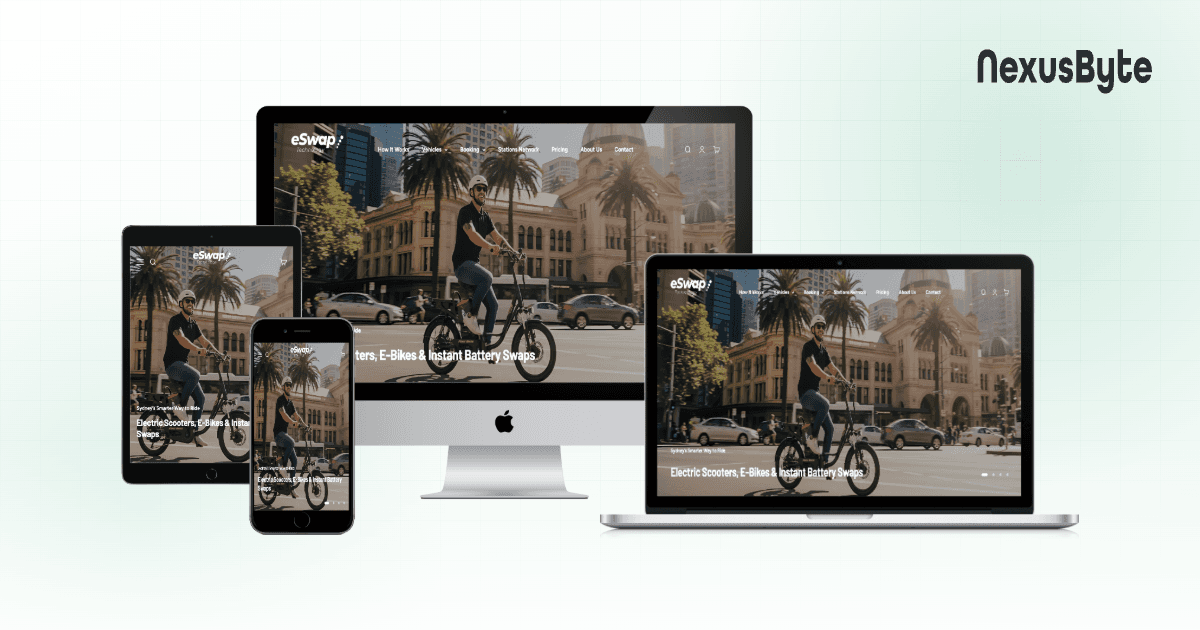
eSwap
eSwap is a Sydney electric mobility business selling e-bikes and e-scooters and running a network of battery swap stations where a flat battery is exchanged for a charged one in under thirty seconds. eswap.com.au is a Shopify build.
Three businesses, one storefront
The design problem here is unusual and worth stating plainly, because it is not a design problem at all until you notice it. Three quite different businesses share this storefront. There is hardware — the Fenix cargo e-bike from $799 and the Voltra Strada scooter from $4,399, each in two finishes, plus the battery itself at $1,300. There is a rental business on weekly and monthly terms, with rent-to-own sitting between the two. And there is the swap network, which is infrastructure and behaves nothing like a product at all.
Those are bought on completely different timescales by people in different states of mind. A purchase is a considered decision made over weeks. A rental is a trial, often made the same day. Access to the swap network is an ongoing relationship. A storefront that treats all three as line items in one catalogue serves none of them, so the site keeps each on its own path and lets a visitor move between them — which is the actual customer journey, since renting is frequently how someone arrives at buying.
Explaining the concept before quoting a price
Most visitors arrive without a working mental model of battery swapping, and until they have one no price on the site means anything. The instinct in e-commerce is to lead with product; here that would have been a mistake. So the how-it-works path sits ahead of the catalogue and reduces the concept to four steps: locate a station on the map, ride to it, swap the flat battery for a charged one in under thirty seconds, keep going.
The point that has to land is that there is no charging. An electric vehicle buyer's entire framework is built around range anxiety and charge times, and swapping removes both — but only once the reader has understood that they are not waiting for anything. Get that across and the rest of the site can talk about price. Fail to, and every specification on the page is being read against the wrong mental model.
The network is the product
For anyone seriously considering the switch, the deciding question is not what the bike costs. It is whether there is a station where they actually ride. So the network gets first-class presentation rather than a footnote — the current stations at Alexandria, Bondi Junction, Rushcutters Bay and Waterloo shown on a map with live availability, and the published roadmap toward sixty stations by 2027 for a buyer weighing a purchase they intend to keep for years.
The commitments around it are treated the same way, because each answers a specific hesitation: complimentary delivery within 3km of any station, a lifetime battery warranty whether the battery is rented or owned, and 24/7 roadside assistance. Test rides and servicing run as bookings rather than as products, since neither ends in a shipped box. Multi-model storefronts of this kind — sales, rental and subscription in one place — are exactly what our e-commerce website service is built to handle.
The SEO build
For a business introducing a category most people have not encountered, the highest-value markup is not product data — it is the explanation. So the FAQ content ships as FAQPage structured data, which makes the questions people are actually asking, such as how battery swapping works and how long it takes, eligible to appear expanded directly in results. That puts the answer in front of someone before they have clicked anything, which for an unfamiliar category is the difference between a visit and a scroll past.
Around it sit an Organization entity, a BreadcrumbList for the navigation hierarchy, and a WebSite entity with a SearchAction. The title does deliberate work by naming the thing and the category together — battery swap stations for e-bikes and scooters — because nobody is searching the brand name yet, and a title leading with it would be invisible. Canonicals resolve consistently, nine Open Graph properties and five Twitter card fields cover the sharing this kind of product attracts, and the sitemap is declared in robots.txt.
The Challenge Of Project
- Selling hardware, rentals and network access from one storefront, when the three are bought on completely different timescales by people in different states of mind.
- Putting the explanation ahead of the catalogue, since a price only means something once the visitor has understood there is no charging wait at all.
- Presenting the station network as a first-class part of the offer, because coverage near home decides the purchase far more than the specification does.
- Publishing the expansion roadmap alongside current stations, since a buyer committing for years is assessing where the network will be, not only where it is.
- Running test rides and servicing as bookings rather than products, because neither one ends in a box being shipped to an address.