
What Is Website Design And Development, Roles And Core Differences
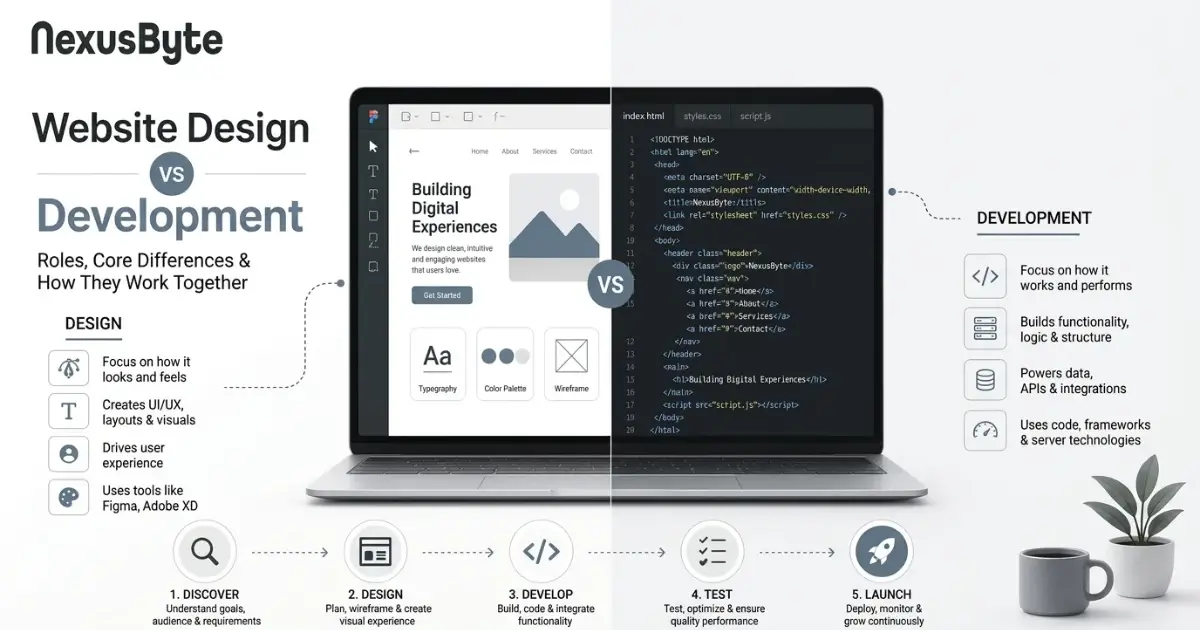
Website design covers everything the user sees and experiences:
- Layout and spacing
- Typography and colour palette
- The logical flow of information across pages
It sits at the intersection of visual aesthetics and user experience. A good web designer thinks about how a visitor moves through a site — not just how it looks in a static screenshot. The goal is a site that communicates clearly, reflects the brand, and guides visitors toward one specific action without confusion or friction.
The primary deliverables from a designer are wireframes and high-fidelity mockups. These exist before a single line of code is written. Think of them as the architectural blueprints before web development begins. Everything gets planned on paper first so that the build phase runs smoothly and inexpensively.
What "Web Development" Actually Means
Web development is the process of taking a design and turning it into a functioning website. Developers write the code that makes buttons work, pages load, forms submit, and content update dynamically. Without development, a beautifully designed mockup is just a picture sitting in a design file. Without design, a coded site can be technically functional but confusing or visually off-putting to real users.
The two roles do overlap in places. Both require at least a working knowledge of HTML and CSS. But expertise diverges quickly: designers lean into tools like Figma; developers work in code editors, frameworks, and server environments. Knowing this divide helps you scope a project correctly from day one.
What Web Designers Actually Do On A Project
Design work starts long before anyone opens Figma or picks a colour palette. A web designer begins with discovery.
This means understanding the brand, the target audience, the site's goals, and what competitors are doing online.
From there, they build a sitemap. It maps out the content structure page by page before any visual work begins.
This planning step prevents a common and expensive problem for any business website — accidentally building pages that don't logically connect to each other.
Once the sitemap is approved, the designer produces wireframes. These are low-fidelity sketches showing where navigation, headings, images, and calls-to-action will sit on each page.
They look simple by design. The point is to validate structure and logic, not aesthetics. Stakeholders can review and redirect the layout at this stage without wasting hours of visual design work.
High-fidelity mockups come next. This is where real fonts, brand colours, photography, and spacing come together. Each page is shown exactly as it will look.
For more complex projects, designers build interactive prototypes that let stakeholders click through the experience before any development begins.
This stage catches misalignments early — when changes are cheap and fast. A strong designer handles UX and UI as one unified discipline. UX covers the logic of how users move through the site. UI covers the visual elements they interact with.
What Web Developers Actually Build: Frontend vs Backend
Frontend developers take a designer's approved mockup and write the code that renders it in a browser. Three languages do the heavy lifting:
- HTML provides the page structure
- CSS controls the visual styling
- JavaScript adds interactivity like dropdowns, form validation, and animations
If a button changes colour when you hover over it, that's frontend code. Frontend developers also ensure the site renders correctly across different screen sizes and browsers. On a modern web, that is non-trivial work.
Backend developers build the infrastructure that powers a site invisibly. This is the core of software development which includes databases that store information, servers that process requests, and APIs that connect different systems.
When you log into an account, submit a contact form, or complete a purchase online, backend logic is handling every step of that transaction.
A site without a backend is essentially a static brochure, no real interactivity, no data, no memory of the user.
For a concise comparison of these roles, see this difference between frontend and backend.
Full-stack developers cover both frontend and backend work. For smaller projects, this is a practical and cost-effective option. One person handles end-to-end functionality without coordination overhead between two specialists. The tradeoff is that a full-stack developer's breadth typically doesn't match the depth of a dedicated specialist in either discipline, which matters on large or technically complex projects.
How A Website Project Flows From Concept To Launch
Every solid website project follows the same four phases:
Phase 1 — Discovery (1–3 weeks) The team defines the site's goals, target audience, content requirements, and technical scope. The output is a project brief and sitemap. Everyone agrees on it before design begins. Skipping this step is the most common reason projects run over budget. Vague briefs create expensive surprises later.
Phase 2 — Design (4–8 weeks) Wireframes come first and take one to two weeks. High-fidelity mockups follow over three to six weeks for a mid-sized site. Rounds of client feedback are built into this phase. Development only starts after the design is signed off. This prevents costly rework mid-build.
Phase 3 — Development (4–12 weeks) Developers build the site from the approved designs. Content creation often runs in parallel during this phase.
Phase 4 — QA and launch A quality assurance phase tests functionality across devices and browsers. It checks load performance and validates that all forms and integrations work. The site goes live only after testing confirms it is stable.
For a typical small business site, the full timeline runs four to eight weeks. That assumes a prepared client and a clear scope.
What Does Building A Website Actually Cost In 2026?
Costs vary widely depending on what you're building. Here's what each tier typically looks like in 2026:
Brochure site (5–10 pages) Price range: $1,500 – $8,000. Timeline: 4–6 weeks. DIY builders cost under $50 per month but trade customisation, performance, and flexibility for convenience. For most local service businesses, a professionally built site lands in the $3,000 to $6,000 range. It tends to convert better than a template.
E-commerce site Price range: $4,000 – $35,000+. Timeline: 6–12 weeks. The upper end covers complex inventory management, custom checkout flows, and third-party integrations.
Custom web application Price range: $20,000 – $100,000+. Timeline: 3–6 months. This covers booking systems, member portals, and similar builds. These are multi-month projects involving multiple specialists working in sequence.
Designer, Developer, Full-stack, Or Agency: Who Do You Actually Need?
If you already have a site and need a visual refresh or a specific technical fix, a freelance designer or frontend developer is usually the fastest and most affordable path. The work is scoped, the timeline is short, and you avoid the overhead of managing an agency relationship. Freelancers also excel at MVPs, proofs of concept, and ongoing maintenance contracts where you need reliable help without a long-term retainer. If you're unsure whether your site should be refreshed or redesigned entirely, learn when a redesign makes sense.
A full-stack developer is the right choice for a new build with moderate complexity on a tighter budget. One person covers end-to-end functionality with streamlined communication. For anything larger — a multi-page site with integrations, SEO strategy, and brand development — an agency is the better fit. They bring a coordinated team: project managers, designers, developers, and QA. The upfront cost is higher. But the risk of gaps, miscommunications, or rework is considerably lower.
The broader principle applies to any technical system that runs a business. In our work at NexusByte, we've seen the same pattern play out repeatedly: thorough planning and proper execution at the start produce reliable, scalable results, while patched-together shortcuts tend to cost more to fix over time than a correct build would have cost originally. Industry research on technical project ROI consistently supports this dynamic. Good results in any technical domain come from expert planning, the right tools, and skilled execution. Understanding what is website design and development, and which roles a project actually needs, is what keeps that pattern from repeating itself in your budget.
Putting It All Together
To answer the question of what is website design and development: design shapes how a site looks and feels, and development builds how it works. Together, they follow a structured sequence, discovery, design, development, testing, and launch. Costs range from a few thousand dollars for a simple brochure site to well above $20,000 for custom applications, with timelines stretching from four weeks to several months depending on scope and complexity.
The right hire depends on what your project actually needs. A visual refresh calls for a designer. A specific technical fix calls for a developer. A new build with full functionality and no existing team calls for a full-stack developer or an agency. Understanding these roles before you start saves time, money, and the frustration that comes from discovering halfway through a project that you hired the wrong person for the job.
Frequently Asked Questions About Website Design And Development
What is the difference between website design and development?
Website design determines how a site looks, feels, and guides users. It covers layout, typography, colour, and user experience. Web development turns those designs into working code. It handles everything from page rendering to databases and server logic. Both are required for a complete, functional website.
Can one person handle both website design and development?
Yes. A full-stack developer with design skills, or a designer who codes, can handle both roles. For smaller projects, this is a practical and cost-effective approach. On larger or more complex builds, dedicated specialists in each discipline typically produce stronger results.
How long does website design and development take?
A typical small business site runs four to eight weeks from discovery to launch. Larger sites with custom functionality can take three to six months. Timeline depends heavily on three things: project scope, how quickly the client provides content and feedback, and whether the design is approved before development begins.
What is website design and development expected to cost in 2026?
A professionally built brochure site ranges from $1,500 to $8,000. E-commerce sites typically fall between $4,000 and $35,000. Custom web applications start at $20,000 and can exceed $100,000 for complex platforms. These figures reflect current agency and freelance market rates based on aggregated industry pricing data.