
How to Choose the Right Technology Stack for a Business Web Application
Choosing the right technology stack is crucial when you create a business web application. The stack plays a large role in the application's performance, speed and usability, and in the overall cost of owning and operating it.
Whatever kind of web application you are creating — a customer-facing application, a management application, a booking system or another business application — performance, speed and cost are always key considerations. The right technology choices at the beginning can prevent an expensive and time-consuming rebuild.
When thinking about the technology choices for a web application, first consider your users and the requirements of your business. Australian businesses need to plan for the future and build for scale. Once you have considered your growth requirements, you can decide on an appropriate technology stack.
This guide gives an overview of the key elements of a technology stack and what to keep in mind when you start a web application development project.
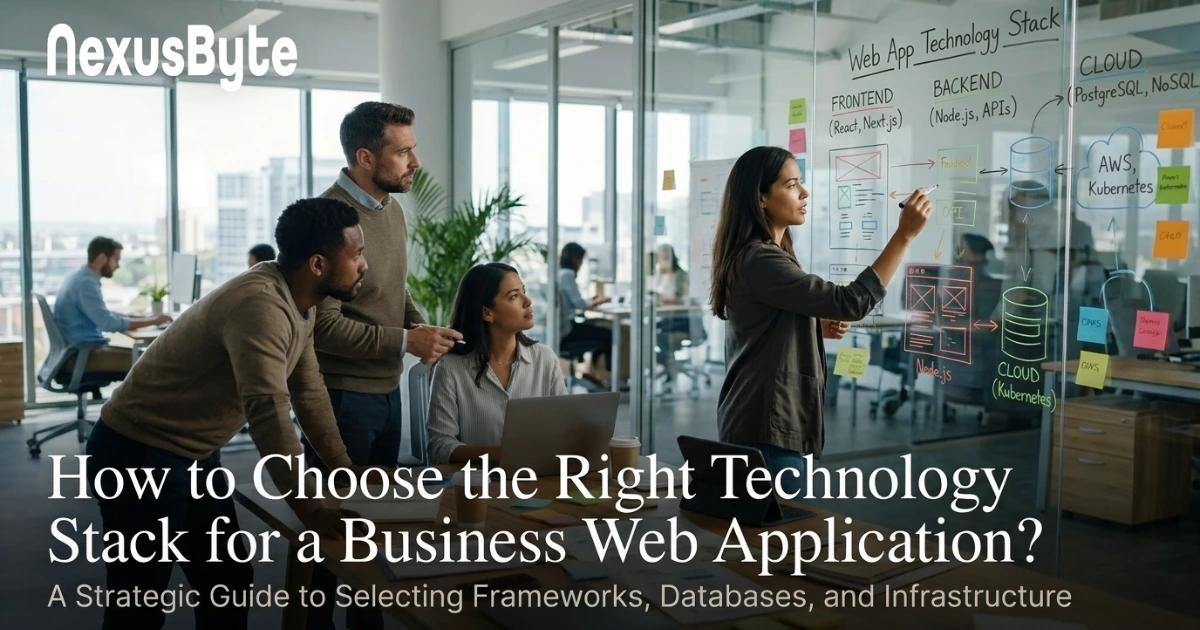
For example, a business application could use React for the frontend, Node.js for the backend, PostgreSQL for the database and AWS for cloud services.
There is no single "correct" way to build an application. The aim is to find the set of technologies that meets your business needs.
What Is a Technology Stack?
A technology stack is the combination of programming languages, frameworks, databases, development tools and infrastructure used to build and operate a software application.
In simple terms, it includes everything developers use to create the part of an application that users interact with, and the systems that process information behind the scenes.
A typical business web application technology stack has four main components.
1. Frontend Development
The frontend is the visible part of an application that users interact with. It includes page layouts, navigation, forms, dashboards, buttons and other interactive elements.
Common frontend technologies include:
- React.js
- Next.js
- Vue.js
- Angular
- HTML, CSS and JavaScript
2. Backend Development
The backend manages the application's business logic, authentication, data processing, APIs and communication between different systems.
Popular backend technologies include:
- Node.js
- Python
- PHP
- Laravel
- Django
- .NET
3. Database Management
A database stores and manages application information, including customer records, transactions, product details, bookings and operational data.
Common database technologies include:
- PostgreSQL
- MySQL
- MongoDB
- Microsoft SQL Server
4. Infrastructure and Hosting
Infrastructure determines where and how an application runs. It includes servers, cloud hosting, deployment environments, monitoring and security configuration.
Common cloud and infrastructure platforms include:
- Amazon Web Services (AWS)
- Microsoft Azure
- Google Cloud Platform (GCP)
- Docker
- Kubernetes
These components work together to create a complete application. Selecting compatible technologies is essential for performance, reliability and long-term flexibility.
Business Requirements to Define Before Choosing a Stack
Before choosing technologies, define what your business application needs to do. Your technology stack should make your business operations easier, not harder.
Here are some important considerations.
1. Define Your Business Objectives
Is your application customer-facing? Is it for bookings or reservations? Is it a management system, a customer relationship management (CRM) system, or a tool for internal use? Defining the nature of the application helps frame the technology and features you need.
For example:
- A booking platform needs scheduling, notifications and payment integrations.
- A CRM system needs customer records, communication history and reporting.
- An inventory management application needs accurate stock tracking and database management.
- An employee portal may need role-based access, document management and internal workflows.
Understanding the application's purpose helps developers recommend an appropriate technology stack.
2. Identify Your Target Users
How many people will use your application, and how many will use it at the same time?
Consider:
- The expected number of users.
- Mobile and desktop access.
- User permissions and access levels.
- Ease of navigation.
- Accessibility requirements.
- User experience expectations.
A clear understanding of user requirements helps determine the frontend framework, authentication methods and application architecture.
3. Estimate Application Complexity
Make a list of the features you think you will need. Will your application need user registration or authentication? Payment integration? Notifications? Reporting and dashboards? Will you need to manage or store documents, or integrate with other applications?
4. Consider Budget and Development Timeline
What is your development budget? It should also cover the costs of the application after it has been built, including maintenance, security and software updates, improvements and support.
Businesses should consider:
- Initial development costs.
- Hosting and infrastructure expenses.
- Third-party software licences.
- Developer availability.
- Maintenance and upgrades.
- Future feature development.
The cheapest technology option is not always the most cost-effective. A suitable stack balances the initial investment with long-term operational value. Our guide to custom software development costs in Sydney covers typical budgets in more detail.
Frontend, Backend, Database and Infrastructure Choices
Once the business requirements are clear, the next step is selecting technologies for each layer of the application.
No single technology stack works for every business. The best option depends on the application's functionality, expected traffic, integration requirements and the development expertise available.
Choosing the Right Frontend Technology
Frontend development determines how users experience the application.
For modern business applications, React, Next.js, Vue.js and Angular are the options most commonly considered.
- React.js: suitable for interactive dashboards, customer portals and applications with reusable interface components. Its component-based approach supports organised frontend development.
- Next.js: builds on React and adds routing, server rendering and performance optimisation. It can be useful when an application combines interactive functionality with publicly accessible pages.
- Vue.js: offers a flexible approach to building user interfaces. It can suit applications that need interactive components without unnecessary complexity.
- Angular: provides a structured framework with built-in capabilities for larger applications. It may suit complex business platforms that benefit from consistent development patterns.
The right frontend framework should support usability, accessibility, responsive design and maintainable code.
Selecting a Suitable Backend Technology
The backend is responsible for application functionality, data processing and communication with other systems.
Some popular backend options include:
- Node.js: useful for API-driven applications, real-time functionality and applications that benefit from using JavaScript across the whole stack.
- Python: suitable for applications involving data processing, automation, analytics and complex business logic.
- PHP and Laravel: Laravel provides a structured framework for building custom business applications, APIs and database-driven platforms.
- Django: a Python framework with built-in features for authentication, database operations and application security.
- .NET: a strong option for enterprise applications, particularly where Microsoft technologies are already part of the IT environment.
The backend should be chosen according to the application's requirements, integration needs and long-term maintenance plans.
Selecting the Right Database
The database is a critical part of the application's architecture because it stores the information the business relies on.
Different databases are designed for different data structures and workloads.
| Database | Best suited for |
|---|---|
| PostgreSQL | Complex business data and relational applications |
| MySQL | Structured data and transactional applications |
| MongoDB | Flexible document-based data |
| Microsoft SQL Server | Enterprise applications and Microsoft environments |
For example, a CRM application may benefit from a relational database, because customer records, communication history and sales activities often have clearly defined relationships.
A content-heavy application with flexible document structures may benefit from a document-oriented database.
The database decision should consider data consistency, query performance, backup requirements, security and future growth. Our database design and development service covers this part of a project.
Choosing Hosting and Infrastructure
Hosting infrastructure affects an application's availability, performance, reliability and scalability.
Cloud platforms such as AWS, Microsoft Azure and Google Cloud let businesses deploy and manage applications without maintaining all of the infrastructure themselves.
When evaluating infrastructure, consider:
- Server capacity and performance.
- Application availability.
- Data backup and recovery.
- Security configuration.
- Monitoring and logging.
- Deployment automation.
- Infrastructure costs.
For businesses in Sydney and across Australia, hosting decisions should also consider data residency, privacy obligations, latency and where users and services are located.
Security, Scalability and Integration Requirements
Beyond its core functionality, a business web application has three further requirements that are critical to supporting the business: the security of business information, the scalability of the application, and its integration with other business systems.
Application Security
Security measures include HTTPS, secure authentication, role-based access control and encryption of sensitive data. Depending on the data it handles, the business should also assess its obligations, if any, under the Privacy Act 1988 and the Australian Privacy Principles.
Important security practices include:
- Secure authentication and authorisation.
- Role-based access control.
- Data encryption in transit and at rest.
- Secure API development.
- Input validation and protection against common vulnerabilities.
- Regular security updates.
- Database access restrictions.
- Automated backups and recovery planning.
Scalability and Future Growth
Your application should be able to process, store and retrieve larger volumes of data and handle more requests than it does today. Cloud-based infrastructure, together with a well-designed application and database, lets an application scale for more users and transactions.
A scalable application architecture should account for:
- Increasing numbers of users.
- Growing database requirements.
- Additional application features.
- Higher API request volumes.
- Integration with new business systems.
- Increased storage and processing requirements.
Developers should avoid unnecessary complexity while making sure the application can evolve as business needs change.
Third-Party Integrations
Most businesses use several applications to support their core processes, such as accounting software, a CRM, a payment gateway, inventory control and order fulfilment. Your application should be able to integrate with these existing applications through application programming interfaces (APIs) to reduce or eliminate manual data entry. Our API development and integration service connects new applications to existing systems.
For businesses in Australia, privacy and security requirements should be built into the core of the application rather than added at the end of development.
How to Choose Between Common Architecture Approaches
The core of a software system can be designed in different ways. Three common approaches businesses should understand are monolithic architecture, microservices architecture and serverless architecture.
1. Monolithic Architecture
Monolithic architecture can be a good option for smaller applications with less complicated requirements. In a monolithic application, the functionality is built as one application, organised into layers such as a presentation layer, a business logic layer and a data access layer.
Advantages:
- Simpler initial development.
- Easier deployment for smaller applications.
- Straightforward communication between components.
- Lower infrastructure complexity.
Limitations:
- Changes can become difficult as the application grows.
- Large codebases may become harder to maintain.
- Scaling individual components independently can be challenging.
Monolithic architecture can be a practical starting point for small and medium-sized business applications with relatively straightforward requirements.
2. Microservices Architecture
Microservices architecture can benefit larger and more complicated applications. The application is split into separate services that communicate with each other, often through APIs or a messaging system. This adds complexity to development, monitoring and infrastructure.
For example, an enterprise application may separate:
- Customer management.
- Payment processing.
- Inventory management.
- User authentication.
- Reporting and analytics.
Advantages:
- Independent development and deployment.
- Flexible scaling of individual services.
- Better separation of business functions.
- Suitable for complex distributed applications.
Limitations:
- More infrastructure and operational complexity.
- Requires effective communication between services.
- Monitoring and troubleshooting can be more challenging.
Microservices are generally more appropriate when the application's complexity and the organisation's requirements justify the additional overhead.
3. Serverless Architecture
Serverless computing lets developers build applications from a set of functions without managing and configuring servers. It suits event-driven applications and some other workloads, but its costs and platform limitations should be analysed carefully.
The best architecture depends on the business case, the application's requirements and the development resources available. A small to medium business application may benefit from a monolithic approach, just as a large enterprise application may benefit from a distributed architecture.
Which Architecture Should Your Business Choose?
There is no universally correct architecture.
A small business application may work perfectly with a well-structured monolithic approach. A large platform with multiple independent services may benefit from microservices, while serverless components can support specific automated processes.
The priority is an architecture that meets current business requirements without adding unnecessary development and maintenance costs.
Common Technology Stack Mistakes
A business may choose an expensive and complex technology solution because of a market or industry trend, and end up with development and maintenance problems.
Avoid these mistakes:
1. Choosing Technologies Just Because They Are Popular
A framework's popularity does not automatically make it a good fit for every project. The choice of technology should be driven by functionality, compatibility and business needs.
2. Ignoring Long-Term Maintenance
Some technology stacks are easy to build with at first but difficult to maintain later, because of a shortage of developers or outdated dependencies.
3. Overengineering the Application
Using microservices, complex infrastructure and unnecessary integrations for a relatively simple application can increase costs without meaningful benefits.
4. Overlooking Security Requirements
Ignoring authentication, access controls, data protection and security updates exposes business information to unnecessary risk.
5. Underestimating Integration Requirements
An application that cannot communicate effectively with existing business systems may create additional manual work instead of improving efficiency.
6. Focusing Only on Initial Development Costs
Businesses should evaluate hosting, maintenance, future upgrades and infrastructure expenses rather than choosing a stack based only on the initial development quote.
A technology stack should strike the right balance between cost, performance, security and the effort needed to maintain the application.
How a Software Development Partner Can Help
Assessing the right technology stack takes in-depth knowledge of both the available technologies and the business's requirements. An experienced development partner can help you evaluate your requirements and technology constraints.
NexusByte develops custom web and business applications tailored to the way each business works.
Our development capabilities include:
- Custom web application development: building applications around specific business processes, operational requirements and customer needs.
- Full stack development: managing frontend and backend development to create connected, functional applications.
- API development and integration: connecting applications with CRMs, payment gateways, third-party platforms and existing business systems.
- Database design and development: creating structured database solutions that support reliable data management and application performance.
- Application architecture: planning secure, scalable and maintainable application structures.
- Ongoing support and improvements: helping businesses maintain, update and improve their applications as requirements change.
Whether you are a start-up building your first business application or an established organisation replacing legacy systems, the right software development approach can make a real difference.
NexusByte works with businesses across Sydney, including the CBD, North Shore, Inner West, Eastern Suburbs and Western Sydney, and with organisations across Australia.
We take the time to understand your needs, recommend the right technologies and build solutions that deliver practical business outcomes.
Want to build a business web app? Discuss your project requirements with the NexusByte team and choose the right technology stack for your business. Contact NexusByte or visit our custom web application development page to discuss your project.
Frequently Asked Questions
What is the best technology stack for web application development?
There is no single best technology stack for every application. React or Next.js could be used for the frontend, and Node.js, Python, PHP or .NET for the backend. The right mix depends on the complexity of the application, the business requirements, scalability needs and integration needs.
Which technology is best for developing a custom business web application?
React, Next.js, Node.js, Laravel, Python and PostgreSQL are some of the most popular technologies used to build custom business applications. The choice depends on the features you need, the data structure, the security needs and the business systems you already use.
What is the difference between full stack development and web application development?
Web application development is the whole process of planning, designing, building, testing and launching a web application. Full stack development describes the scope of the development work within that process: a full stack developer or team builds both the frontend users interact with and the backend, database and APIs behind it, so both sides are designed to work together.
How much does it cost to develop a business web application in Australia?
It depends on the features, integrations, security requirements and the amount of design and testing involved. As an indicative 2026 Australian market range, a basic internal business tool can cost $15,000 to $40,000 and a custom web application or customer portal $40,000 to $150,000, excluding GST. Hosting, maintenance and future development should be budgeted for as well.
How do I choose a software development company in Sydney?
Look for a team with experience building applications similar to yours, a clear discovery and scoping process, and a written quote that sets out what is and is not included. Confirm who will own the source code, how security and privacy will be handled, how changes are managed and priced, and what support is available after launch.