
What Businesses Need to Know About Software Development Services
You've been told you need custom software. Maybe a developer pitched you a booking system, a client portal, or a full CRM rebuild. You nodded along, quoted a number back to your accountant, and then quietly Googled "what are software development services" because you still weren't sure what you'd actually be paying for. That's more common than most providers would admit.
At NexusByte, we've had this conversation regularly over years of working with Sydney businesses. The confusion isn't about intelligence. It's about an industry that loves acronyms and abstracts what are, at their core, pretty practical outcomes. So here's the straightforward version:
- What software development services actually cover
- What they cost
- How delivery works
- How to evaluate a provider without getting burned
What Are Software Development Services: An Overview
Software development services aren't the same as getting a website built. A simple brochure website may be primarily front-end, whereas software development typically includes back-end logic, data storage, and integrations.
Software development services refer to the full scope of professional services where a provider plans, designs, engineers, tests, and deploys a working software product for a business. That includes:
- Web applications and internal tools
- Mobile apps
- Custom CRM systems
- API integrations and automation workflows
- Data platforms
A tradie needing a job-scheduling app that connects to their invoicing software — that's a software development engagement.
A retailer needing a custom inventory management dashboard connected to their e-commerce platform — same category.
For a thorough taxonomy of what falls under this umbrella, see a complete overview of the types of software development services.
The distinction matters because scope, timeline, and cost differ significantly from a standard website build. What you're commissioning is engineered functionality, not a design.
The deliverables you should expect
A properly scoped software development engagement delivers several concrete things:
- A working, tested codebase
- Technical documentation
- Source code ownership explicitly assigned to you in writing on payment
- Deployment to a server or cloud environment
- A structured handover so your team can actually use what was built
Note: pre-existing tools, libraries, and third-party components are typically licensed rather than assigned to you outright.
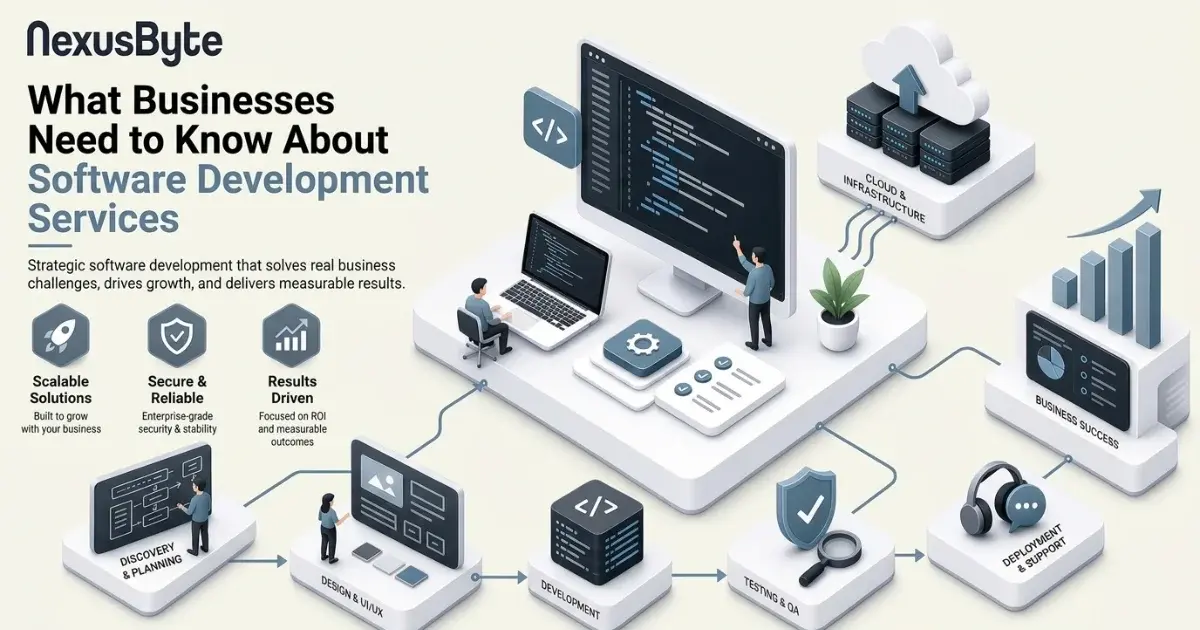
The software development lifecycle (SDLC) organises all of this into defined phases: discovery, requirements analysis, design, development, QA testing, and deployment. Each phase has clear outputs. You know what's happening and when — rather than receiving a surprise finished product three months later.
When a provider walks you through the SDLC upfront, it's a good sign. It shows they've done this before and they understand that clients need visibility, not just a final deliverable.
What's typically not included by default
Here's where businesses get caught out.
These three things are generally out of scope unless you specifically contract for them:
- Ongoing hosting
- Post-launch bug fixes beyond the standard warranty window (usually 30 to 90 days)
- IT infrastructure management
A provider who builds your app isn't automatically responsible for keeping the server it runs on patched and secure.
These gaps are real, and understanding them before you sign anything saves a lot of frustration. We'll come back to this later, because it's one of the most important structural decisions you'll make.
The core service types most businesses actually need
Custom web applications and CRM systems
Custom software development means building a solution for your specific business need rather than buying an off-the-shelf product and bending your processes to fit it. The most common deliverables for small and medium businesses are web applications and custom CRM systems, think client portals, booking platforms, and job management dashboards.
Businesses choose custom builds over established platforms for a few consistent reasons: full IP ownership, lower cost at scale once licensing fees compound, and exact-fit functionality that matches how the business actually operates. This is especially true for businesses that have outgrown off-the-shelf tools and need enterprise software solutions built around their actual workflows.
A construction company with a unique quoting and job-tracking workflow won't find that built into a generic CRM. A custom-built system handles it precisely, without workarounds.
Mobile apps and API integrations
Mobile application development services produce native or cross-platform apps for iOS and Android, usually when a business needs its team or customers doing something specific on a phone that a website can't handle well.
API integrations are a separate but equally important category. They connect two or more existing platforms so they share data automatically. Common examples include:
- A booking system that pushes confirmed jobs into accounting software
- A payment gateway that updates a customer database in real time
These integrations are the connective tissue of modern business software. They're among the most commonly requested services from businesses that already have tools in place but can't get them talking to each other.
System modernisation and automation
Many businesses are running software that was built years ago and can't connect to anything modern. Software engineering services in this space either replace the legacy system entirely or rebuild it with a modern front end — starting with proper database design and development as the foundation. A third option wraps it with new interfaces that allow integration without a full rebuild. Business process automation sits alongside this: using software to eliminate manual, repetitive tasks like data entry, report generation, or approval routing. AI-driven automation is an emerging layer on top of this, offering smarter triggers and decision support, though realistic scoping matters here. The fundamentals of good automation still apply before any AI layer adds value.
Delivery models: who builds your software and how
There are four ways a business gets software built. Each carries a different cost structure and risk profile.
In-house You hire developers as employees. Maximum control, maximum overhead, and a hiring pipeline that takes months to build.
Outsourced A defined project is handed to an external vendor who takes ownership of delivery. This suits discrete, well-scoped builds with a clear start and end date.
Managed development An ongoing engagement where a provider manages your entire development function under an SLA. The closest model to having a dedicated external tech team without the internal headcount.
Staff augmentation Staff augmentation sits between in-house and outsourced: external specialists who integrate into your existing team and work under your direction. The risk of delivery stays with you, but you gain targeted skills without permanent hires.
Which model actually suits a small or medium business
Most SMBs don't have the consistent development volume to justify a full in-house team. For a one-off build, a booking system, a customer portal, a specific integration, outsourced project delivery is the right model. For businesses with a product roadmap and ongoing development needs, managed development services provide continuity, accountability, and a team that accumulates context over time rather than starting from scratch on every engagement. The key question is simple: do you have a single project or an ongoing pipeline? Your answer determines the model.
What it realistically costs and how long it takes in 2026
Cost and timeline ranges by project type
These are honest benchmarks, not quotes. The main variables that move these numbers are team location, project complexity, and scope changes mid-build.
MVP Timeline: 2 – 4 months | Cost: $25,000 – $120,000
Custom web application Timeline: 3 – 8 months | Cost: $40,000 – $300,000
Mobile app Timeline: 3 – 9 months | Cost: $50,000 – $220,000
API integration Adds 10 – 30% to the base project cost
What team location does to your budget
Australian-based providers, including local Sydney teams, sit at the higher end of the hourly rate spectrum. Mid-level contract rates run AU$80 to $120 per hour.
Offshore teams in India, Eastern Europe, and the Philippines typically range from AU$20 to $60 per hour for comparable skill levels.
The cost difference is real. But so are the trade-offs — time zones, communication overhead, and local accountability all factor into the true cost of going offshore.
The ongoing maintenance cost most businesses underestimate
Post-launch maintenance isn't optional; it's a standard budget line. Industry benchmarks put annual maintenance at 10 to 20% of the original development cost. For a $100,000 build, that's $10,000 to $20,000 per year covering security patches, dependency updates, performance monitoring, and minor feature adjustments — much of which falls under ongoing networking and cybersecurity management rather than the development contract itself. Businesses that skip this budget don't avoid the cost; they just pay it later in larger, more disruptive fixes when outdated dependencies cause failures or security vulnerabilities go unpatched.
What to look for when shortlisting a software development company
Portfolio, certifications, and relevant experience
A strong portfolio shows similar project types, measurable client outcomes, and relevant domain experience, not just polished screenshots. Ask for case studies that describe the problem the client had, the solution that was built, and the result it produced. Vendor certifications from Microsoft, AWS, and Google Cloud indicate that a provider works with current infrastructure and has passed external platform validation, useful signals of technical competence in those specific environments.
These aren't vanity badges; they help determine which tools and environments a team can competently work in. Independent standards such as ISO 27001 and SOC 2 are also worth asking about, particularly if security and compliance matter to your project.
Contract terms that protect you from day one
Four clauses are non-negotiable in any software development services agreement:
1. IP ownership Explicit written assignment of source code and all custom deliverables to you on payment. Make sure terms around any pre-existing or third-party components are clearly stated — what the developer retains and what is licensed to you.
2. Warranty period 30 to 90 days post-launch covering defects against the agreed specification.
3. Change request process Written approval and impact statements required before any out-of-scope work begins.
4. Post-launch SLA Defined response times for critical bugs versus minor issues.
Any provider who is reluctant to discuss IP ownership before contracts are signed is flagging a problem. Under Australian law, copyright doesn't transfer automatically; it requires explicit written assignment. Make sure it's in the contract.
The questions that reveal a provider's real capability
The discovery conversation tells you more than the proposal. Ask: how do you handle scope creep? Who owns the code if we part ways before launch? What does your QA process actually look like? What happens in the first 90 days after launch? A provider who answers these confidently and in plain language has delivered projects before. A provider who deflects, generalises, or rushes past the question is showing you something important before you've committed a dollar.
Why bundling software development with IT support changes the equation
The hidden cost of managing multiple vendors
After a custom application is built and deployed, it lives on infrastructure that needs ongoing management: security monitoring, patch cycles, uptime tracking, and integration health checks.
When the company that built your software and the company managing your IT infrastructure are two different businesses, responsibility gaps appear. They are more common than most clients expect. Security patches get delayed because each vendor assumes the other is handling it.
Something breaks and both parties point at each other while your team waits. The coordination overhead costs time and money that many businesses don't account for when they start shopping for a development partner.
What a full-service provider actually delivers
NexusByte is built around exactly this model. The same team that designs and builds your software also manages the infrastructure it runs on, handles cybersecurity, monitors uptime, and supports your broader IT environment. Clients work with a single point of contact who has full context across every layer of their technology stack, from the application code to the network it runs on. There's no finger-pointing between vendors, no gaps in responsibility, and no moment where your business falls between two service agreements.
That's backed by platform certifications across Microsoft, AWS, and Google Cloud, and years of hands-on work with Sydney businesses on custom web apps, CRM builds, API integrations, product development services, and managed IT infrastructure. The combination of development capability and operational depth means your software keeps working long after launch day.
Conclusion
If you've been asking "what are software development services", here's the short answer: it's the full professional scope of planning, building, testing, and deploying working software for your business. That covers:
- Custom software development
- Web applications and CRM systems
- Mobile apps
- API integrations
- Legacy modernisation and automation
Delivered through in-house teams, outsourced projects, or managed ongoing engagements.
Costs are real but predictable when a project is properly scoped, and the right provider is identified through portfolio evidence, relevant certifications, clear contract terms, and honest answers to direct questions.
The point most businesses miss when they start looking for a software development company is the post-launch picture. Who manages the infrastructure? Who owns the security patching? Who picks up the phone when something breaks six months later? Bundling development and IT support with one provider answers all three. It's not a convenience, it's a structural advantage that reduces risk and reduces cost over the life of the software.
If you're ready to scope a project or just need to talk through what you actually need built, start with NexusByte. Plain language, no sales pressure, and a team that's still there six months after the launch.