
What to Expect from a Web Development Company in Sydney
The Sydney web development market is crowded, and that's putting it politely. There are many agencies, freelancers, and "digital studios" competing for the same clients, with pricing that ranges from $3,000 for a basic freelancer build to $30,000 or more for a bespoke platform, all for what can appear, on the surface, to be essentially the same thing.
For a business owner trying to make a sound decision, it's genuinely difficult to know who to trust. If you're searching for web development Sydney businesses can rely on, the difference between a good outcome and a costly mistake usually comes down to the questions you ask before you sign anything.
After 12 years of building websites for Sydney businesses, we've had a front-row seat to how this plays out.
We've seen clients come to us frustrated after paying another company and receiving something that didn't work, didn't load properly, or simply never launched. We've also seen clients walk in with sharp, specific questions and walk away with exactly what they needed because they knew what to ask.
This article gives you that same foundation: the questions that separate reliable partners from risky ones, what projects actually cost, how to evaluate portfolios properly, and the warning signs that should send you straight for the exit.
Questions to Ask Any Web Development Sydney company Before You Sign
Most business owners evaluate agencies based on how professional the website looks and how confident the pitch feels. That's an understandable starting point, but it's not a reliable filter.
The agencies that let clients down the most aren't always the ones with bad websites, they're often the ones with polished sales processes and weak delivery. A structured set of questions cuts through that.
Who on Your Team Will Actually Build My Website?
This is the question most agencies hope you won't ask. Many agencies follow a pattern where a senior team runs the sales process, then delegates the work to junior staff or offshore contractors once the contract is signed, a risk that's widely reported across the Sydney market and frequently cited by clients who've had poor experiences.
The outcome is often inconsistent quality, poor communication mid-project, and a finished product that doesn't reflect the capability you saw during the pitch. Ask for names and roles. Ask whether the build team is in-house. A confident, direct answer means they have nothing to hide. Deflection, vagueness, or a sudden pivot to "we have a collaborative global team" is your signal to dig harder.
What's Included in This Scope, and What Gets Billed Separately?
Scope creep is the most common reason web projects blow their budgets. What looks like a fixed-price quote often has a long list of exclusions buried in the fine print. Before you sign anything, push for explicit written confirmation of what's covered: content migration, mobile responsiveness testing across devices, browser compatibility QA, SSL setup, staging environment, and post-launch fixes for bugs discovered within 30 days.
That 30-day post-launch window is an industry-recognised best practice that any professional company should commit to in writing. Anything not listed is potentially a billable extra. A trustworthy Sydney web development company will put this in writing without hesitation. If "we'll sort that out as we go" is the answer, that's how budgets double.
Can I Speak to a Client You've Worked with in the Past 12 Months?
Portfolio case studies on a company's website are curated highlights, chosen specifically to impress.
They tell you what the company wants you to know. A direct conversation with a past client tells you how they actually communicated under pressure, whether timelines held, how they handled problems, and whether the client would use them again. A strong company will offer references without hesitation. Reluctance to provide them is a meaningful signal about what working with them is actually like.
What Web Development in Sydney Actually Costs in 2026
One of the most common reasons web projects go wrong is a mismatch between what a client thinks they're paying for and what's actually being delivered. Getting clear on real market rates prevents both overpaying and being sold a project that's underscoped from the start.
The Real Price Range for Small to Mid-Sized Business Sites
For a professionally built small business website through a reputable Sydney company, expect to pay between AUD $5,000 and $15,000 for a standard brochure-style site.
Many professional builds fall in the $5,000 to $12,000 range, with Sydney rates sitting higher than the national average because of market demand and senior developer costs; hourly rates typically run $80 to $200 or more.
Ecommerce development projects, custom integrations, or anything requiring a bespoke web application typically start at $15,000 and can reach $30,000 or more depending on scope.
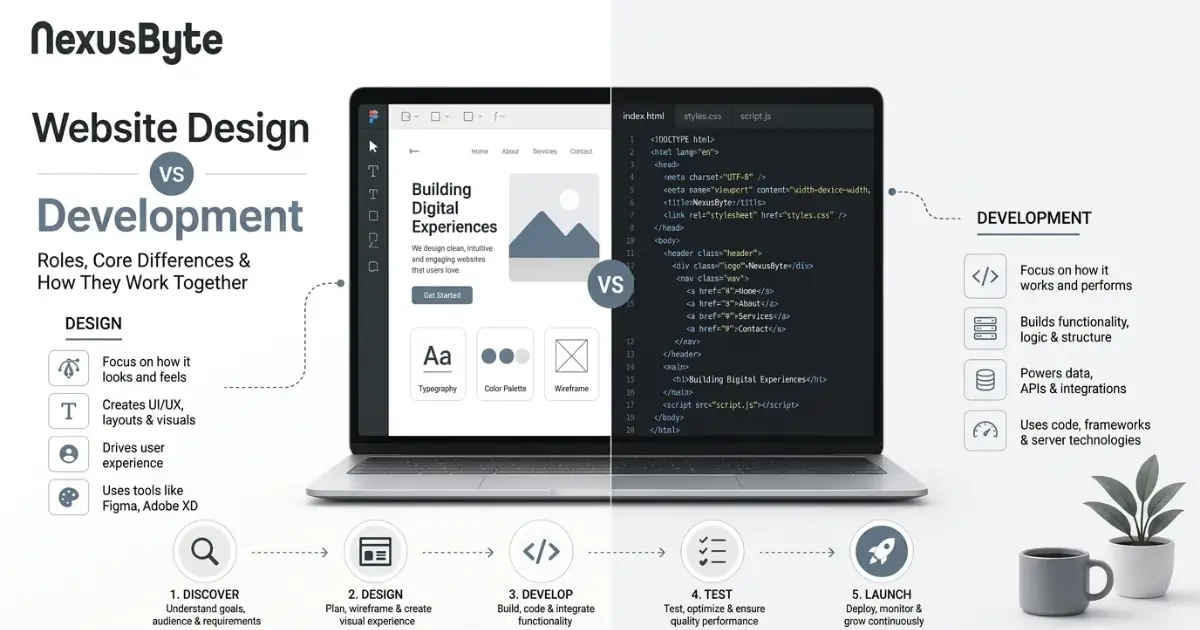
Freelancers offer lower prices in the $3,000 to $8,000 range, but they rarely provide the project management, QA process, or post-launch support that a business-critical site needs. If the design and build roles are still unclear, start with what website design and development actually involves.
What a Realistic Timeline Looks Like from Discovery to Launch
A standard WordPress or Shopify build by a competent Sydney team typically takes 6 to 10 weeks from discovery to launch for a mid-complexity project.
The phases break down like this: discovery and scoping runs 1 to 2 weeks, design and development takes 3 to 6 weeks depending on complexity, QA and client revisions add another 1 to 2 weeks, and final launch and handover takes roughly a week.
Simpler projects can move faster; more complex builds can stretch to 14 weeks or beyond. Custom web development projects with complex integrations, booking systems, or unique user flows typically run 3 to 6 months.
Any company promising a complete custom build in under 3 weeks is either cutting corners or setting you up for a painful revision process after launch.
Ongoing Costs That Get Left Off the Quote
The build fee is only part of the story. Hosting runs $100 to $500 per month depending on traffic and infrastructure requirements.
Maintenance and security updates add $100 to $2,000 per month based on the level of support. Domain registration, SSL renewal, plugin licensing, and CMS fees are smaller but real ongoing costs that add up.
Before signing a contract, ask for a 12-month total cost projection, not just the upfront build figure. A trustworthy company gives you that number willingly.
How to Read a Web Development Portfolio the Right Way
Most people evaluate a portfolio by asking whether the designs look attractive. That's the wrong question. Aesthetic taste is subjective, and a beautiful site that loads slowly, ranks nowhere on Google, or converts at 0.5% is a failure regardless of how it looks. The right framework focuses on outcomes and technical relevance.
Measurable Outcomes Matter More Than Visual Design
Strong portfolios from Sydney's top-performing agencies show actual results: a 125% improvement in mobile page speed, 242% year-on-year organic traffic growth, 264% conversion rate uplift, or measurable ROI from integrated SEO and development work.
These aren't invented benchmarks; they're the kind of results that appear in documented case studies from agencies that track performance after launch.
If a portfolio shows only design screenshots with no performance data attached, ask the company directly what happened to those sites' traffic and conversion rates after launch. The answer tells you a lot. You can also cross-check a company's case studies and client reviews against third-party directories such as Clutch to validate claims and find additional references.
Matching Their Technical Stack to Your Business Needs
WordPress remains the dominant platform for content-driven small and mid-sized business sites across Sydney, and for good reason: it's flexible, well-supported, and easy to hand back to clients after launch.
Shopify is the right call for ecommerce projects where inventory management and payment processing are central.
React and full-stack custom builds are appropriate for businesses that need complex user flows, booking systems, or web applications that go well beyond a standard informational site.
The question to ask is which platforms the company specialises in and whether those platforms actually suit what your business needs, not what the company prefers to build because it's faster or more profitable for them. If you're trying to hire a web developer in Sydney, this stack conversation is one of the clearest ways to test whether a company is thinking about your outcomes or their own.
Warning Signs That Tell You to Walk Away
These aren't edge cases. They're patterns that appear consistently in failed web projects, and recognising them early saves significant time and money.
Vague Proposals and Prices That Keep Shifting
A reliable web development partner gives you a written scope with clearly defined deliverables and fixed pricing, or explains a transparent time-and-materials model with a realistic estimate and a cap. If the quote is a single dollar figure with no breakdown of what's included, if every follow-up question is met with "it depends," or if the price changes between conversations without a clear scope change to explain it, stop.
Transparent pricing isn't just a sign of professionalism. It's the foundation of a working relationship that doesn't end in a dispute.
No Plan for What Happens After Launch
A website isn't a finished product the moment it goes live. It needs regular security patches, CMS updates, performance monitoring, and a clear process for when something breaks.
Any company that can't explain their post-launch support model in specific terms, who you contact, what the response time is, what's included versus billable, is leaving a serious gap in your plan.
Ask directly: if something breaks at 9 pm on a Friday, what happens? The answer reveals whether this company sees your site as an ongoing responsibility or a closed transaction.
Why Working with a Local Sydney Team Changes the Outcome
The argument for local web development isn't about sentiment or patriotism. It's about context, accountability, and what actually produces better results for a Sydney-based business.
What Local Experience Actually Means for Your Project
A company that has built websites for Sydney trades, retailers, hospitality businesses, and service providers understands how local customers search online.
They understand, for example, how Google Maps rankings can vary across different suburbs, how copy tends to read differently depending on the audience in different parts of the city, and what mobile-first design means for someone searching from their phone on a commute.
That knowledge isn't theoretical, it comes from years of delivering websites in this specific market and watching how real local audiences interact with them.
The One-on-One Model Versus the Company Machine
Large digital agencies in Sydney operate with account managers, creative directors, production teams, and handoff chains. By the time your project reaches the person writing the code, several communication handoffs have happened, and the nuances of your brief tend to erode at each one.
Smaller specialist teams, like the crew at NexusByte, give you a direct line to the people doing the actual work from the first call through to launch day.
When a question comes up mid-build, it gets answered by someone who knows the full context of your project, not by an account manager relaying messages between departments.
What Great Local Web Development Actually Looks Like
The benchmarks are consistent regardless of project size: a clear written brief before any work begins, regular progress updates throughout the build, a staging environment where clients review and approve before anything goes live, thorough handover documentation, and a defined support arrangement post-launch.
At NexusByte, this process is supported by partnerships and accreditations across major cloud platforms, which means local and personal doesn't mean technically limited. It means enterprise-grade capability delivered with the kind of direct communication that larger agencies simply can't match at scale.
Making the Right Call for Your Business
Finding the right web development partner in Sydney comes down to a few things done consistently: asking the right questions before you commit, understanding what projects actually cost so you can spot an underscoped quote or an inflated one, evaluating portfolios on outcomes rather than aesthetics, and choosing accountability over brand name or logo recognition.
The biggest mistake most business owners make is rushing this decision because they're excited to get started. Spending an extra two weeks vetting the right partner is far less painful than spending four months recovering from the wrong one. Ask for references. Ask for a line-by-line scope. Ask who builds the thing. The answers will tell you everything you need to know.
If you want a straight conversation about what your project actually involves, what it should cost, and whether we're the right fit for it, reach out to the NexusByte team. No sales pitch, just an honest assessment from people who've been doing this web development Sydney work for over a decade. We're here when you're ready to start.